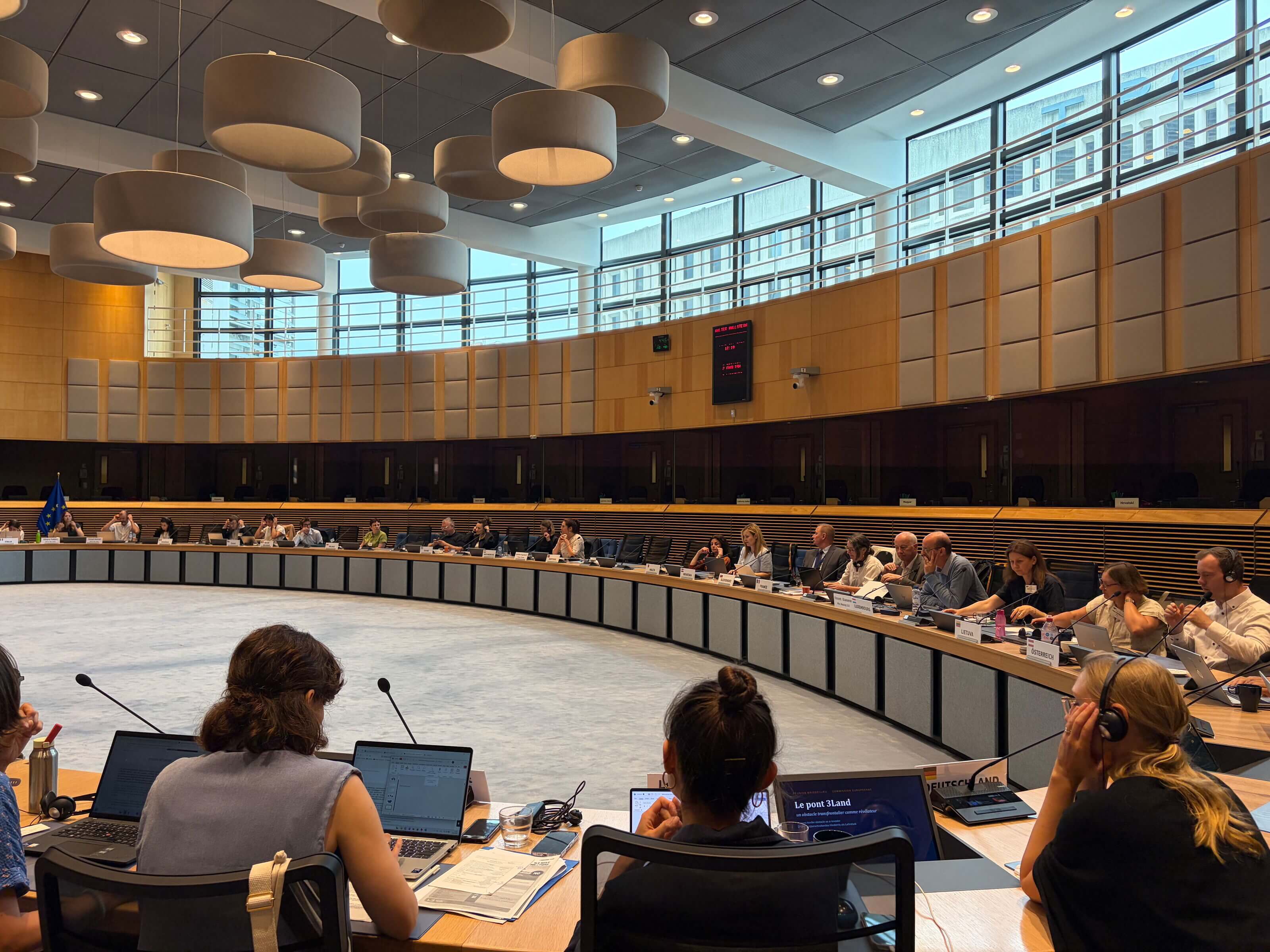
The TEB in Brussels for the implementation of the BRIDGEforEU Regulation
by Caroline Romang
On 30 June 2026, Valentine Hagenbach, 3Land project manager at the Trinational Eurodistrict Basel (TEB), represented the Eurodistrict in Brussels, at the Berlaymont building, at the second coordination meeting devoted to the implementation of the BRIDGEforEU Regulation. Organised by the European Commission (DG REGIO), the meeting brought together the Member States, the bodies responsible for applying the new Regulation and project promoters, in order to share their experiences during the roll-out phase.
The BRIDGEforEU Regulation in brief
Adopted in May 2025 (Regulation (EU) 2025/925 on a Border Regions' Instrument for Development and Growth), BRIDGEforEU creates a voluntary framework designed to remove the legal and administrative obstacles that hold back infrastructure and public services at borders. Each Member State designates the body responsible for receiving and examining "cross-border files": a Cross-Border Coordination Point (CBCP) or a competent authority for border matters. A project promoter may submit a file to it; the CBCP or the competent authority then examines the request within set deadlines and is required to respond. The decision to actually remove the obstacle nonetheless remains a national prerogative.
The 3Land bridge, a cross-border obstacle as a case in point
During the panel devoted to concrete cases of obstacle removal, Valentine Hagenbach presented the project for a bridge over the Rhine between Huningue and Basel, the centrepiece of the 3Land development scheme. The message is this: a cross-border infrastructure is first and foremost a legal and administrative obstacle before it is a technical challenge. As soon as a structure crosses a border, it crosses a limit of sovereignty, which raises questions as to the applicable law, the allocation and interplay of authorisation powers, and the designation of the contracting authority. It is precisely on this type of question that a Cross-Border Coordination Point or a competent authority would come into its own: a single point of contact for the project promoter, an examination procedure with set deadlines, and an orderly coordination of the powers and stakeholders to be brought together.
The TEB set out how it has moved forward thanks to two complementary European tools: the b-solutions initiative, which made it possible to establish the legal diagnosis (the study by Professor Michael Frey, submitted at the end of 2023, concluded that an international treaty between France and Switzerland was necessary), and a project financed by Interreg VI, which partly covers the preliminary feasibility studies. A useful clarification: although the structure is Franco-Swiss, and therefore located on an external border to which BRIDGEforEU does not apply, the project is indeed trinational, with Germany contributing to its financing. The type of obstacle, however, recurs in identical form on internal borders, notably the Franco-German ones. The case is Swiss, the lesson is European.
A stimulating and hopeful meeting
The presentation also highlighted what such a mechanism, whether a CBCP or a competent authority, could bring where the current tools show their limits: a lasting point of entry, an obligation to respond backed by enforceable deadlines, and a structured mobilisation of all the stakeholders concerned. These exchanges with the Member States proved stimulating and full of hope for the future of cross-border cooperation. It remains to be seen how these principles will translate into practice, given that the tool remains voluntary and the final decision national. In particular, it will be worth observing whether files are handled by the Cross-Border Coordination Point itself or by the competent authority designated by each Member State, and how this new framework will unfold in practice. It is precisely this concrete implementation that the TEB will follow closely.